

My journey.Two paths.
My musical life has always moved along two distinct yet deeply entangled routes: the intimate storytelling of acoustic fingerstyle guitar and the experimental frontier of electronic sound, synthesis, and imagined worlds. Those paths now unfold across four albums, each exploring a different scale, method, collaboration, and state of attention.
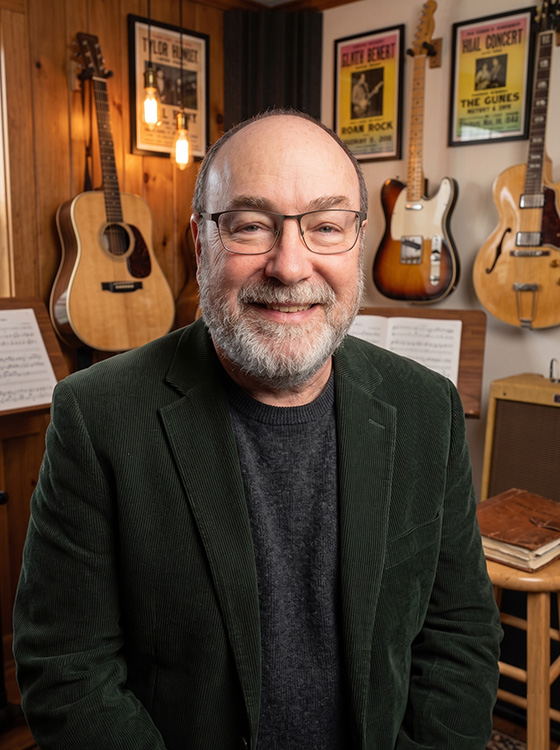
One imagination, expressed through two paths and four albums.
From the wood and steel of an acoustic guitar to the limitless possibilities of a digital synthesis system, the goal has remained the same: to discover how sound can hold a memory, portray a relationship, build a landscape, or bring an impossible scene to life.
These paths do not compete with one another. They inform each other. The discipline of counterpoint shapes the electronic work, while the freedom of sound design keeps the musical palette open to surprise. Promethean Conception expands into large electronic architectures, Mantis narrows the focus into trance and Mutation Synthesis, and Electronica For Mammals opens the work into collaboration, electronic percussion orchestra, and multi-timbral synthesized soundscapes.
The acoustic path
Solo fingerstyle guitar, alternate tunings, open strings, melody, harmony, counterpoint, and music built from the distinct energy of personal relationships.
Explore All New Good Songs for Guitar →The electronic path
Keyboard composition, algorithmic systems, Direct Digital Synthesis, Mutation Synthesis, tape manipulation, granular sound, and percussion orchestras written for imagined futures and altered listening states.
Explore Promethean Conception →Explore Mantis →
A life spent following sound wherever it leads.
The route from classical guitar lessons to science-fiction percussion orchestras was never straight—and that is precisely what made it useful.
Foundations and eclectic roots
My musical journey began with classical guitar lessons as a Beatles-obsessed twelve-year-old in upstate New York. I was lucky enough to have Frederic Crislip as my classical guitar teacher. He was truly the first person who set me on an unwavering musical path and prepared me very well at a young age to play fingerstyle guitar for the rest of my life. During high school, I found myself juggling three almost unrelated instruments: transcribing bass parts for jazz ensemble, hauling a bass drum through summer parades, and navigating the cold, unforgiving tuba in concert band. Those experiences created an appetite that moved freely from 1960s psychedelic rock and jazz to avant-garde experimentation. Not insignificantly, Mr. Crislip did everyting he could to talk me out of the Tuba...
The acoustic revelation
The turning point happened by chance on Halloween in 1986. After a disastrous plumbing accident nearly derailed the evening, my friends and I made it to a Hot Tuna concert in New Jersey. Watching Jorma Kaukonen perform original fingerstyle compositions revealed how my classical training could become a language for writing my own music. Later, in San Francisco, longtime friend and mentor Grant Miller helped refine that language through alternate tunings, melody, harmony, and counterpoint.
The electronic frontier
Running parallel to the acoustic work was a lifelong dedication to electronic instruments and systems. I studied under electronic music pioneer Joel Chadabe, learning algorithmic composition and pattern-recognition systems that functioned as early forms of musical artificial intelligence. I later worked for his company, Intelligent Music, helping commercialize sequencing software such as M and Realtime.
Sound as raw material
Seeking to push further, I studied for two years at the Mills College Center For Contemporary Music. There, I earned an MFA in Electronic Music and Recording Media. Studying with Alvin Curran and Maryanne Amacher deepened my interest in radical sound design, improvisation, recording technology, phase vocoding, graphic composition, and the transformation of everyday sounds into new musical timbres.
Synthesizing two worlds
Today, my electronic work follows several broad avenues: traditional keyboard music, Direct Digital Synthesis, Mutation Synthesis, granular and transformed sound, and what I call Science Fiction Percussion Orchestra. The latter joins my marching-band past to my love of speculative storytelling, using detuned and non-Western percussion to score scenarios such as an army of giant trees marching on Washington. Mantis brings these experiments into a concentrated fifteen-part sound collage designed for close listening and trance-like focus. The acoustic work remains equally personal, shaped by the unique emotional frequency of each person or animal who inspires a piece.
Discipline, accident, curiosity.
The work grows from formal technique, unlikely encounters, and the willingness to follow a sound before knowing where it will end.
Technique
Classical guitar, alternate tunings, counterpoint, jazz harmony, keyboard composition, and a long practice of learning what the hands can make possible.
Systems
Algorithmic composition, Mutation Synthesis, granular sound, synthesis engines, phase vocoders, tape machines, software instruments, found sound, and recording studios used as instruments.
Imagination
Science fiction, giant insects, walking forests, impossible landscapes, family stories, friendships, animals, dreams, trance states, and the emotional charge of memory.

“Whether through the intricate wood and steel of an acoustic guitar or the limitless possibilities of digital synthesis, I continue to run, stroll, skip, and explore.”Seth Peter Clark
Four albums, with one still unfolding.
The current catalog offers four entry points into the same creative life: intimate acoustic composition, expansive electronic architecture, concentrated altered-state listening, and a collaborative pre-release built from electronic percussion orchestra and multi-timbral synthesized soundscapes.
All New Good Songs for Guitar
Fourteen solo steel-string compositions inspired by family, friendship, animals, memory, separation, and return.
Promethean Conception
Twenty-three works spanning solo keyboard, Direct Digital Synthesis, found-sound transformation, and Electronic Percussion Orchestra.
Mantis
A fifteen-part sound collage designed for close listening and trance states, centered on Mutation Synthesis, composite waveforms, transformed timbres, and the memory of Patty Liu.
Electronica For Mammals
A collaborative album by Seth Clark, Hugo Keith, and Grant Miller featuring electronic percussion orchestra, multi-timbral synthesized soundscapes, and four currently available preview tracks.
The path is the work.
Explore the four album worlds, including the evolving Electronica For Mammals pre-release, along with their stories, videos, technical notes, and visual work.